

“Shalom!” a cheerful man carrying a guitar case called out to us with a wave as we stepped out of my car in the parking lot of the Central Reform Congregation in St. Louis. This was our second stop of our day of looking for labyrinths in St. Louis. After driving all around the city and through some obviously underserved neighborhoods, we found ourselves in a much different neighborhood, one of lavish homes and beautifully landscaped lawns and avenues shaded by tall old trees.
After waving back to the man as he got into his car and drove away, Erin and I were drawn to the lush garden that took up a big portion of the congregation’s backyard. Flowers and vegetables sprouted this way and that in a large square space, and brilliant sunflowers towered over everything, guarding the labyrinth. This was a labyrinth I had learned about through a friendly cohort on a labyrinth enthusiasts’ Facebook page. She had shared a video of Robert Fishbone talking about building the labyrinth at CRC, his congregation. On his website, Fishbone shares photos of the process and explains: “After two years of planning, I led 30 members of the congregation in building our labyrinth, modeled after the biblical, walled city of Jericho.” He and the other members of this Jewish community worked together, in silence, to build the labyrinth I was about to enter. Knowing this, and with the guitar-man’s “Shalom” still ringing in my ears, I stepped onto the grassy path. Almost immediately, tears began to fall from my eyes. I have had some powerful emotional reactions to labyrinths, but this was very different. Knowing what I knew about the story behind this labyrinth, the community who collectively laid the stones here in contemplative silence, the artistry and meaning behind it and the heritage of the congregation that worshiped every week in the temple behind me overwhelmed me. A great beautiful sadness wrapped around me as I felt the energy of the grief of the Jewish people and their historic suffering, but tempered by that was a joy and hope in the verdant soft grass growing up beneath my feet. My tears continued to seep from my eyes, and quiet sobs dropped from my lips as I also grieved my own ignorance, an awakening to all the things I do not truly know, cannot ever fully comprehend. I can read books and watch movies and talk with people who have experienced things, but a sorrow of this life is realizing that - try as we might - we can never truly know what it is to walk in the shoes of another person. My vicarious despair over a history of injustice lashed upon an entire creed of people lasted even as I stepped off of the labyrinth and carried me to a stone bench in the corner of the congregation’s yard, where I took many moments to compose myself as I wrapped my head around the feelings that had erupted so unexpectedly on the labyrinth.
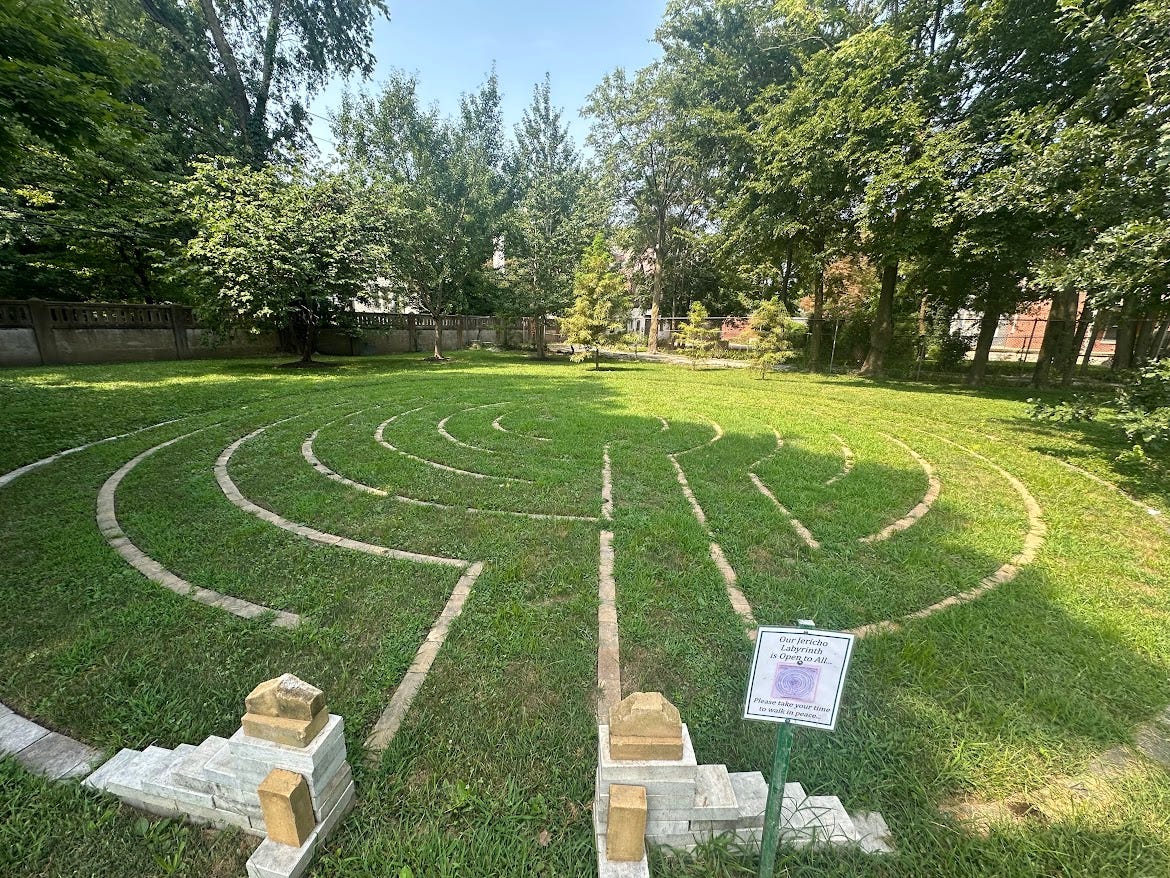
As I sat on the bench and contemplated my labyrinth experience, Erin took her turn. As she wound her own way through the labyrinth’s path, I contemplated things I could do in order to learn more about the ancient faith that had birthed my own. I committed to studying the Jewish faith, not to convert but simply to grow in my own understanding of people whose lives and history are far different from my own.
Lesson #2 of the day: A great sadness of being human is that we can never fully know what it is to live outside of our own experience, but that doesn’t mean we should stop learning and growing in compassion and understanding.
What a beautiful and extremely meaningful labyrinth. Thank you for sharing your very heartfelt experience.