

Our labyrinth tour of the city took us next to Congregation Shaare Emeth, where we drove around the impressive campus a bit before finding their Chai Labyrinth. After parking in their vast lot, we made our way over to the pergola-like structure that welcomed us into the labyrinth space. Looking back now, the structure reminded me a bit of a sukkah that would be erected during the Jewish celebration of Sukkot, the Festival of Booths. (This is a bit of information that I learned in the weeks after our labyrinth tour as I studied Jewish holidays and Hebrew words to appreciate the culture more.)
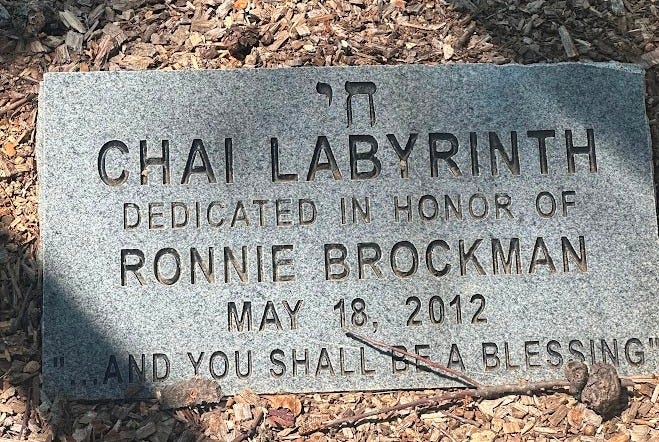
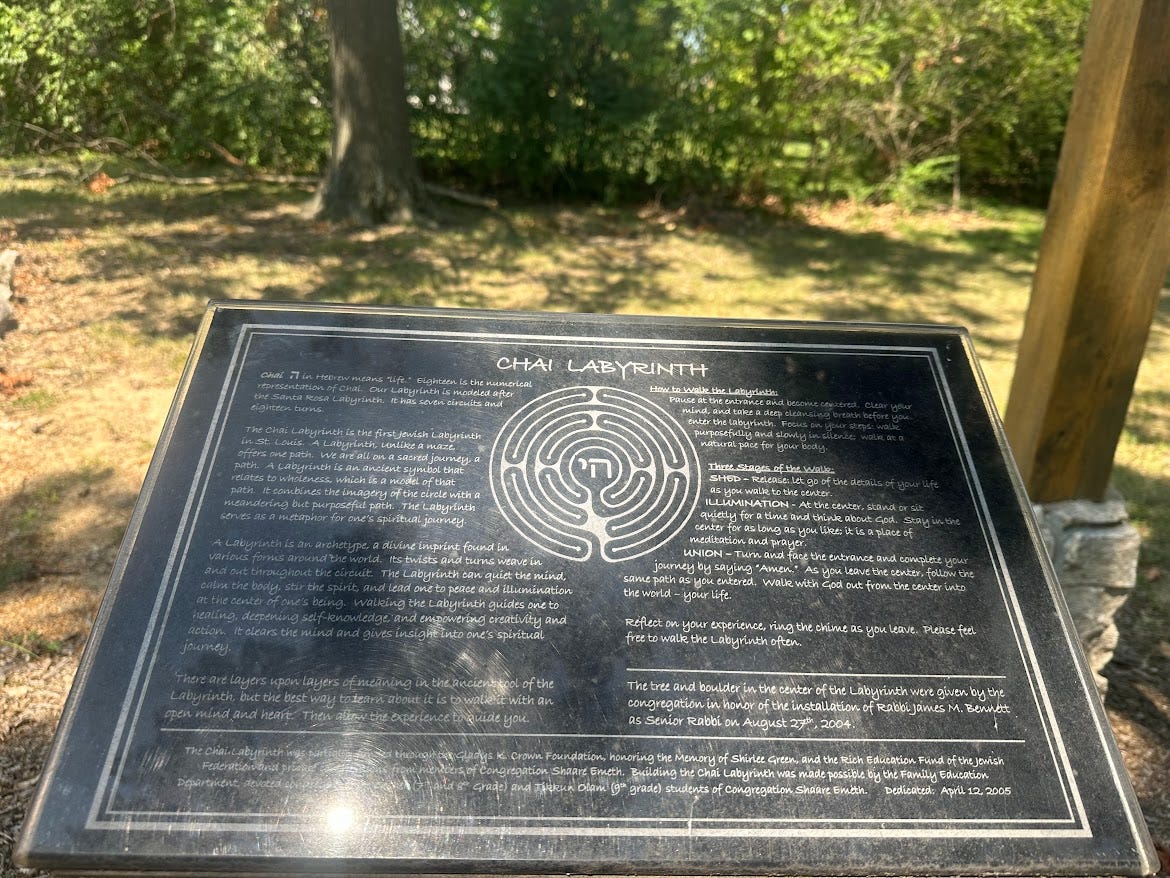
Within this structure, we found a plaque that shared some illuminating information about the labyrinth we were about to walk:
“CHAI LABYRINTH- Chai in Hebrew means ‘life.’ Eighteen is the numerical representation of chai. Our Labyrinth is modeled after the Santa Rosa Labyrinth…
The Chai Labyrinth is the first Jewish Labyrinth in St. Louis.
A Labyrinth, unlike a maze, offers one path. We are all on a sacred journey, a path.
A Labyrinth is an ancient symbol that relates to wholeness, which is a model of that path, it combines the imagery of the circle with a meandering but purposeful path. The Labyrinth serves as a metaphor for one's spiritual journey.
A Labyrinth is an archetype, a divine imprint found in various forms around the world. Its twists and turns weave in and out throughout the circuit. The Labyrinth can quiet the mind, calm the body, stir the spirit, and lead one to peace and illumination at the center of one's being.
Walking the Labyrinth guides one to healing, deepening self-knowledge, and empowering creativity and action. It clears the mind and gives insight into one's spiritual journey.
There are layers upon layers of meaning in the ancient tool of the Labyrinth, but the best way to learn about it is to walk it with an open mind and heart. Then allow the experience to guide you…”
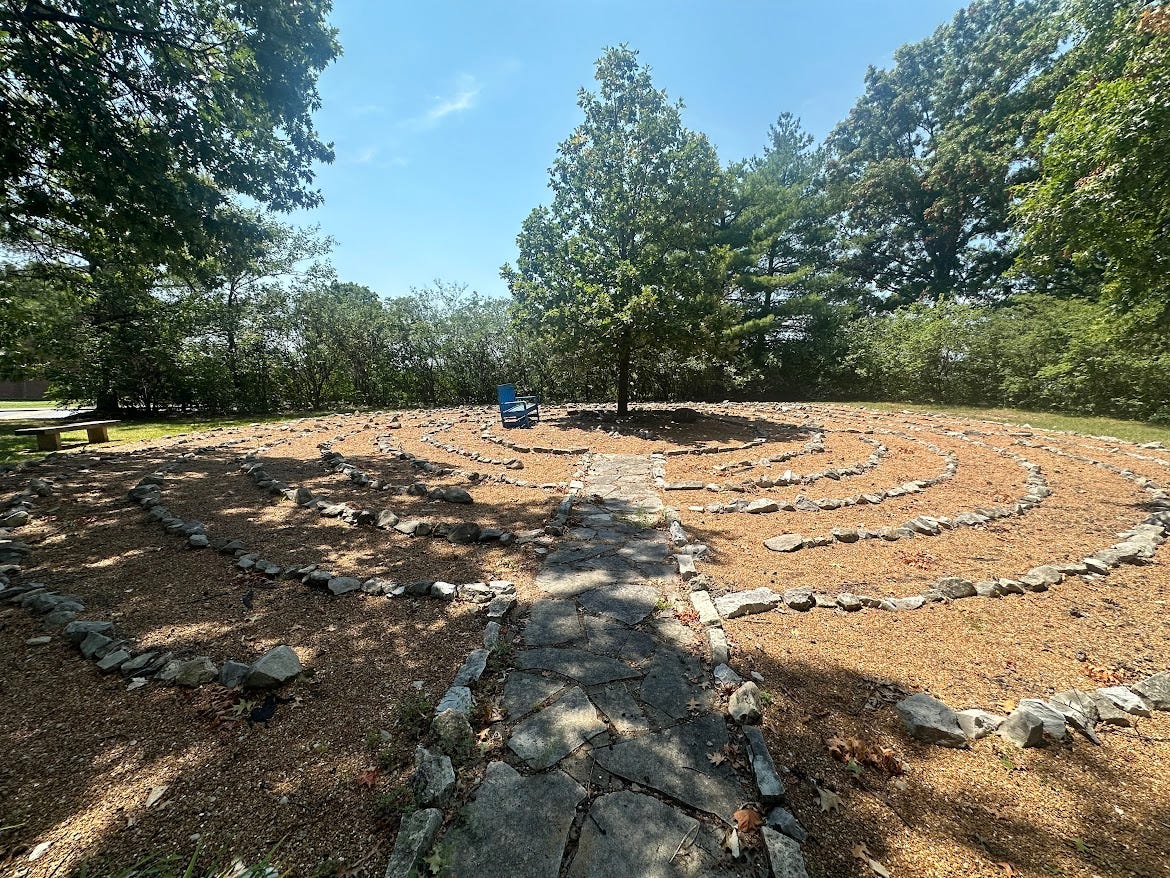
It was with an open mind and heart that I stepped onto this beautiful labyrinth, made of pea gravel with large stones directing your feet along the path. The pea gravel was the exact same that is in my backyard where we are hoping to create our own labyrinth, so it felt like a bit of inspiration as I walked the path, intent on keeping my footing on the shifting surface.
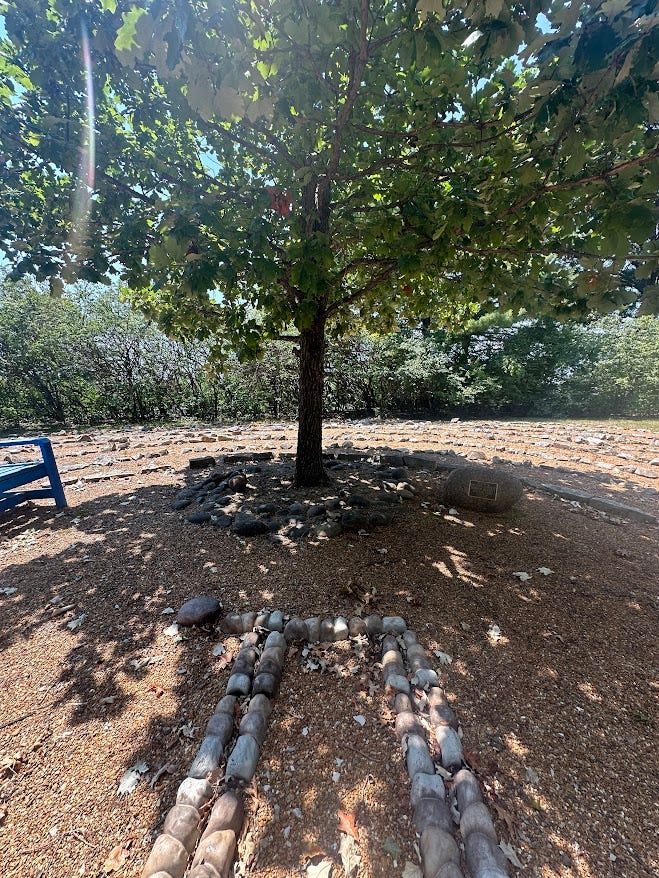
Breathing the Hebrew words that were on my heart that day - SHALOM and CHAI, I took my time wandering through the twists and turns of this journey until I reached the center, where the congregation had laid out stones in the shape of the Hebrew letters for CHAI. There, behind the stones and alongside a comfortable blue bench, was a large oak tree. As I took a seat on the bench and gazed up at the oak, I realized that at almost each labyrinth I had recently encountered there had been an oak tree present, in some places planted as if to guard the labyrinth.
Considering the oak tree and wondering at its symbolism (I know that botanicals often have deep meaning), I traced my steps back out of the labyrinth to give Erin her turn.
While she made her way through, I wandered over to another space on the campus, an area that gave homage to the original temple and its congregants. I found another comfortable spot to sit and pulled out my phone to do a quick bit of research on oak trees. What I discovered took my breath away because, of course the symbolism is spot on: Oak trees stand for ancient wisdom, survival and strength, the perfect tree to live at the center of the CHAI Labyrinth and as sentinels around the Dayspring labyrinth and alongside the labyrinths we were to walk later in the day because these structures embedded in the ground are much like the soaring branches of the oak: they tap into an ancient wisdom and allow us the strength to survive.
Lesson #4: Oak trees and labyrinths have much to teach us about life, CHAI.
The mighty oak. I'm not surprised. Lovely learning more each time you share.