

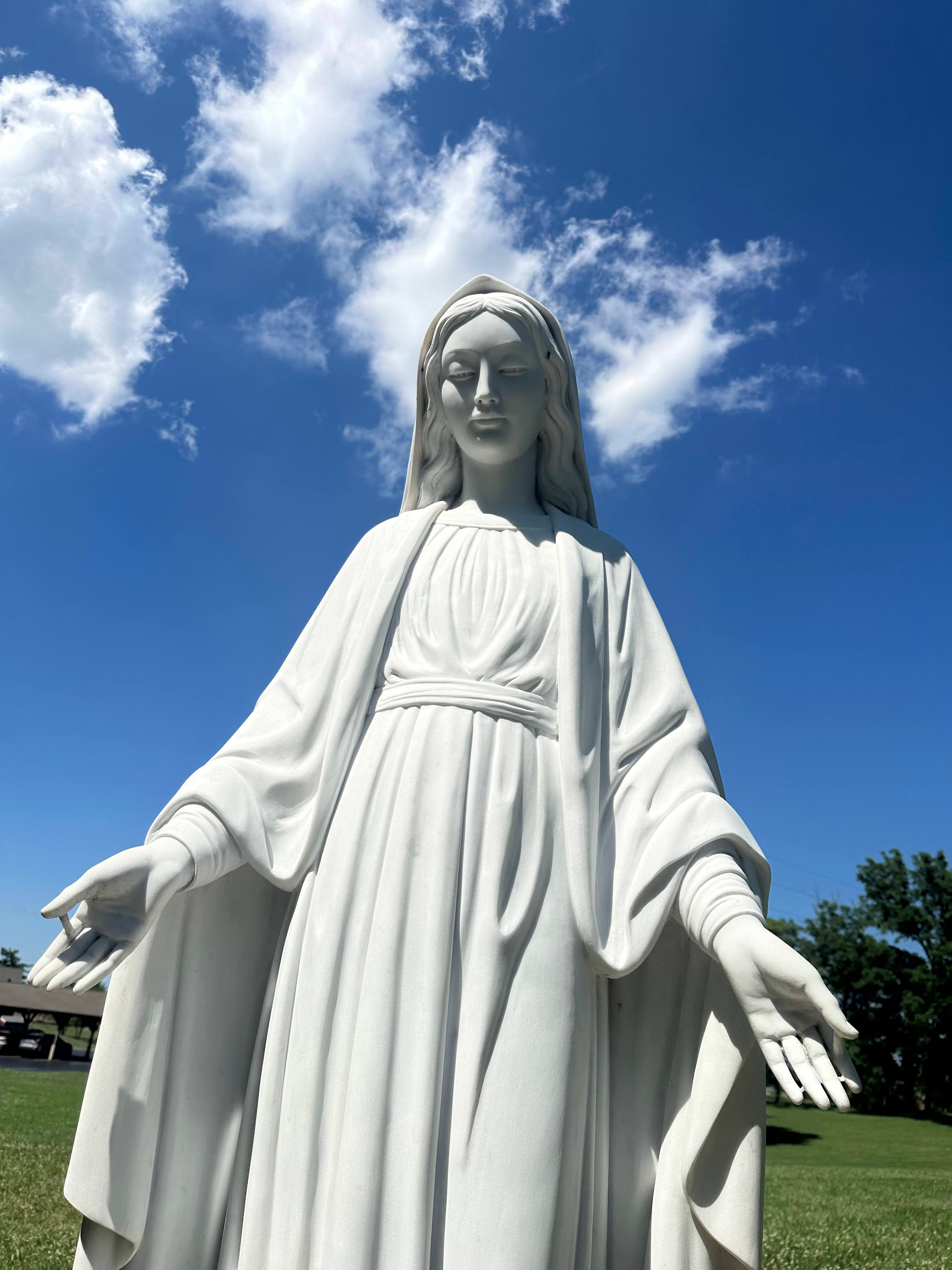
If you were to visit my parents’ home on Olive Street, you would find the Virgin Mary prominently displayed in their landscaping alongside well-tended plants, a proud American flag, a large stone with their last name carved in it and a few gnomes. This Mary has been there longer than most of those other pieces, and I have distinct memories of her from my childhood. I recall sitting on the ground near her and looking at her toenails that my dad had carefully painted; I remember the grass green snake curled up under her toes, at such a young age that I didn’t understand the symbolism of that creature and the power of her crushing it under her well-manicured heel. I can still see her outstretched hands and her baby blue gowns and her Mona Lisa smile gazing down at younger me.

After years away from the Catholic Church and its reverence for the mother of Jesus, I have found myself returning to Mary in these past few seasons. In the little-c church world that is often focused on the masculine, I have been drawn to study the sacred feminine through reading and retreat and conversation and prayer and Bible study; I have learned about female mystics and desert mothers, diverse women like Julian of Norwich and St. Teresa of Avila and St. Clare of Assisi and, of course, those women of the Bible who have often been underestimated and under celebrated: Eve and Ruth and Naomi, Esther and Elizabeth and those unnamed women like the woman at the well and the woman affected by blood.

Of all of these women I encountered, the Marys were the ones who called to me the most: Mary of Bethany and Mary of Magdalene, fascinating women with many untold stories only alluded to in the scriptures and, of course, the young Mary of Nazareth who was visited by an angel and told that she would carry and birth and raise and love the Son of God as only a mother can. The Mary of the Anunciation, the Mary of the Nativity, the Mary of the Pieta is the Mary that I continue to return to over and over again.


I spent a few summers studying Mary Magdalene, and she still remains a curiosity, an enigmatic mystery and a woman I seek after, but the Mother of Jesus is a foil to the Magdalene in her simplicity, a transcendent simplicity in a world of complications, a beautiful simplicity that emanates in all the shrines dedicated to her around the world.
We are fortunate to have one such shrine not very far from our home, the Shrine of the Miraculous Medal in Perryville, Missouri. Run by the Association for the Miraculous Medal, this beautiful campus is a wonder to behold. Nestled in a small community 80 miles south of St. Louis, the people of Perryville and lovers of the Virgin Mary have built an astounding space telling the story of the Miraculous Medal through historic buildings, statues of saints, a rosary walk, a meditation labyrinth, grottos, a lovely babbling brook and a shrine that is filled with stunning artwork and stained glass, chapels and some astonishing relics, including a sliver of the True Cross.


According to the Association’s website, “Saint Mary's of the Barrens was founded in 1818 by the Vincentian fathers. The National Shrine of Our Lady of the Miraculous Medal was built in 1929 by the Promoters of the Association of the Miraculous Medal. While looking at the altar of the Shrine, the elements of the front and the back of the Miraculous Medal should be evident. The statue above the altar and the words in the archway, ‘O Mary, conceived without sin, pray for us who have recourse to Thee,’ depict the front of the medal. The back of the medal is depicted in the base of the altar with the large ‘M’ surmounted by a cross (through Mary's intercession we pray with confidence to God), the twelve stars symbolizing the apostles, who are the foundation stones of the Church, and the stars of heaven (Mary is Queen of Heaven).” This medal came to be after Mary appeared with instructions to Saint Catherine Labouré, at the time a novice in the community of the Daughters of Charity in Paris, three times in 1830. The first medals were struck in 1832, and miracles began to abound in association with the medals; miracles continue to happen today, and many people carry the medal as a testament to the power of faith.


My own grounding in the power of faith has led me to a desire for pilgrimage. Just today I was reading back over some journaling I had done a few years ago where I was contemplating pilgrimage and what that might look like for me. Interestingly enough, the opportunity for pilgrimage has presented itself in surprising ways in this season of my life. After my first solo pilgrimage to visit the Shrine of Our Lady of the Rivers in Portage des Sioux, Missouri earlier this year, the Shrine of the Miraculous Medal was the next on my list, so one Sunday my husband and son joined me on a trek to visit Mary’s Shrine.
The day was uncomfortably warm, nearing 100 degrees, but we persevered and walked the campus, stopping to read the dedications stamped into the walkway and to take photos of the statuary. My husband and I walked the glittering stones of the labyrinth under the June sun and visited each of the sculptures that encircled it, each figure dedicated to a different story of how Mary had worked miracles around the world, places and stories I was familiar with like Guadalupe and Lourdes and Fatima and places that I was just learning about like Knock and Altotting. As I stood in front of each representation of the Mother of Christ, I was struck by all the ways this one woman has shown up in the world, all the places she has appeared, all the people she has touched.


While people have many different ideas about the sacred feminine, standing in that sacred space of the Shrine and seeing all of these diverse images of one woman, I was struck by not just her sacredness but by the sacredness of all women and all men, by the sacredness of all people. A chord of recognition rang within: No matter where I am in my spiritual walk, no matter how I am feeling about myself, no matter how complicated the world may be, humanity is sacred. Mother Mary is sacred in all her forms; Jesus is sacred in His incarnate humanity; the unnamed women of the Bible are sacred; Julian of Norwich and St. Teresa of Avila and St. Clare of Assisi are sacred; Eve and Ruth and Naomi, Esther and Elizabeth and Mary Magdalene and Mary of Bethany are sacred; the impoverished woman fighting to survive half a world away is sacred; the woman of privilege and prestige (who has her own hard story too) is sacred; the little child not yet touched by the cares of the world is sacred; the child whose innocence has already been stolen by the vices of brokenness is sacred; the teenager contemplating life and death is sacred; the teenager engrossed in a video game is sacred; I am sacred; you are sacred. Maybe that is one thing we all can take away from this shrine, any shrine really, any sacred space: the reminder of our own sacredness.
.